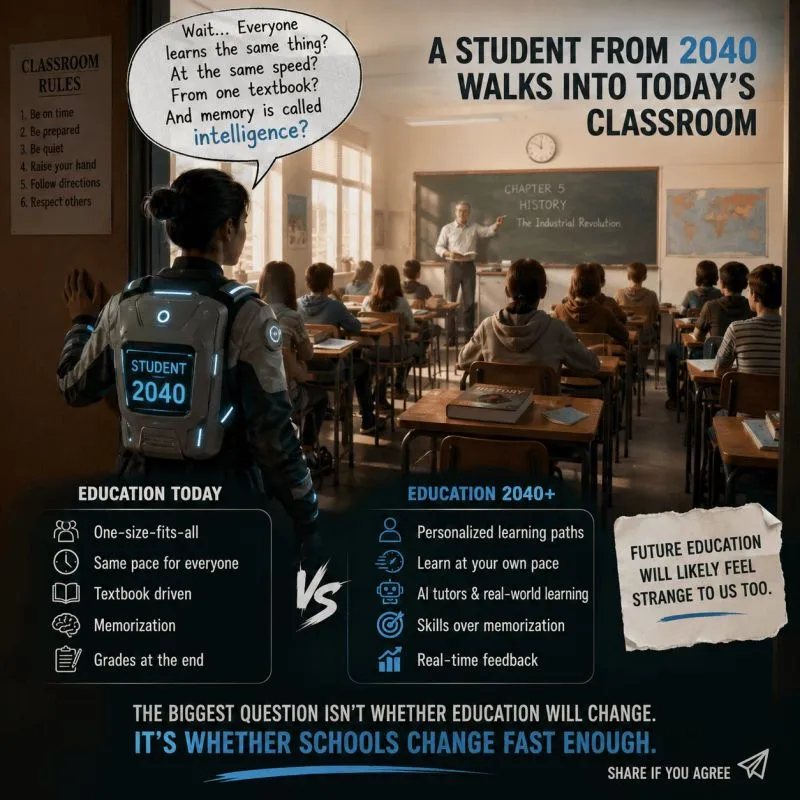
A Student From 2040 Walks Into Today's Classroom
Imagine a student from the future visiting a classroom today. What would shock them — and what does that tell us about how urgently education needs to change?
Imagine a student from 2040 stepping into a typical classroom today.
They walk in, look around, and slowly take in the scene. Rows of desks. One teacher at the front. A single textbook open to the same page for every student. A lesson moving at one pace — regardless of who’s keeping up and who’s already lost.
After a long pause, they ask:
“Wait… everyone learns the same thing? At the same speed? From one textbook? And you measure intelligence by how much they can remember?”
It sounds like a thought experiment. But it’s a useful one — because it forces a question we rarely stop to ask: Is the way we educate students today actually the best we can do?
What Today’s Classroom Looks Like From the Outside
When you’re inside a system, it’s easy to accept it as normal. Classrooms, textbooks, exams, grades — these structures have existed for so long that they feel like natural features of education rather than design choices made at a specific point in history.
But they are design choices. And they were made for a different world.
The standardized classroom model was built during the industrial era, when the goal of education was largely to produce a workforce that could follow instructions, retain information, and perform consistent, repeatable tasks. Uniformity was a feature, not a bug.
The world that model was designed for no longer exists.
What Education in 2040 Might Look Like
Predicting the future is uncertain work. But based on where technology and pedagogy are already heading, a student in 2040 will likely experience something very different:
AI tutors that know each student’s learning history, adapt explanations in real time, and never run out of patience or time.
Personalized learning paths where students don’t move through a fixed curriculum at a fixed pace, but progress based on demonstrated understanding — moving faster where they’re strong, slowing down where they need more time.
Skill-based progression where advancement is tied to what a student can actually do, not how long they’ve been sitting in a classroom.
Real-time feedback that tells students immediately what they got right, what they got wrong, and — crucially — why.
Less memorization, more application — because in a world where any fact is a voice command away, the value of storing information in your head is declining. The value of knowing what to do with information is rising.
The Uncomfortable Question
Here’s what the thought experiment really asks us to confront:
If a student from 2040 would be shocked by today’s classrooms, what does that say about how well today’s classrooms are serving today’s students?
Not future students. Current ones. Students who are already living in a world of instant information, AI tools, and rapidly changing career landscapes — but spending their days in a system designed for a world that no longer exists.
The biggest question isn’t whether education will change. It will. Technology alone will force it.
The question is whether schools, curricula, and institutions change fast enough to serve the students who are in classrooms right now.
Because those students can’t wait for 2040.
They need an education that prepares them for the world they’re actually going to live in — not the world the system was originally built for.
The future is coming. The only real choice is whether we meet it — or get left behind by it.