Why Rote Learning Is Failing Students — And What Real Learning Looks Like
Memorizing answers can help you pass exams. But it won't help you solve real problems. Here's why rote learning falls short and what should replace it.
Ask a student to recite the definition of photosynthesis, and many can do it perfectly. Ask them to explain why plants near a window grow differently than plants in a dark corner — and suddenly, the memorized definition isn’t enough.
That gap is the rote learning problem.
What Rote Learning Actually Does
Rote learning — the practice of memorizing information through repetition — isn’t entirely without value. It has its place. Multiplication tables, historical dates, chemical symbols — some things are worth committing to memory.
But when memorization becomes the primary method of learning, something important gets lost.
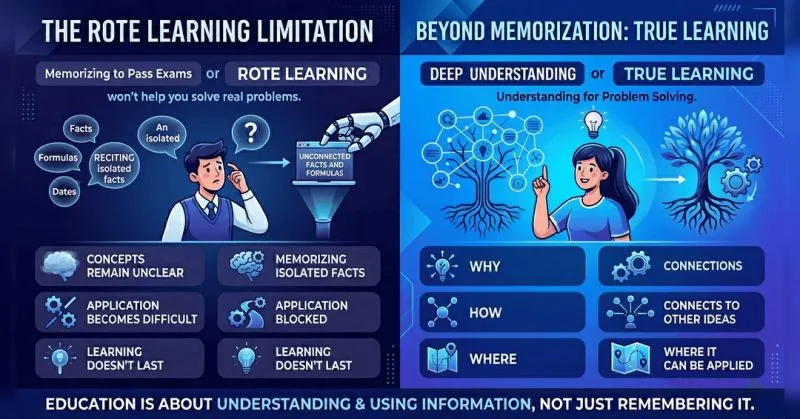
Students who rely heavily on rote learning often face three specific problems:
Concepts remain unclear. When you memorize a definition without understanding what it means, you have words — not knowledge. You can reproduce the answer, but you can’t work with it.
Application becomes difficult. Exams that test memory are one thing. Real-world problems — and even many higher-level exams — require you to apply what you know to new situations. Memorized answers don’t transfer.
Learning doesn’t last. Information memorized without understanding fades quickly. Most students forget a significant portion of what they crammed within days of an exam. That’s not learning — it’s temporary storage.
The Difference Between Remembering and Understanding
True learning happens at a deeper level. It’s not about storing information — it’s about building a mental model of how something works.
When you genuinely understand something, you know:
- Why it works — the underlying logic or principle, not just the surface fact
- How it connects to other ideas — because knowledge doesn’t exist in isolation; concepts link to each other in ways that make both easier to understand
- Where it can be applied — which is ultimately the point of learning anything
A student who understands why a mathematical formula works can derive it from scratch if they forget it. A student who only memorized it is stuck the moment their memory fails.
What Real Learning Looks Like
Shifting away from rote learning doesn’t mean abandoning structure or rigor. It means changing the goal.
Instead of asking “Can you remember this?”, the goal becomes “Can you use this?”
That shift changes how students study. Instead of reading and re-reading notes, they test themselves. Instead of copying definitions, they explain concepts in their own words. Instead of memorizing examples, they try to generate new ones.
It also changes what good teaching looks like. A teacher who helps students understand why something is true — not just what is true — builds knowledge that lasts and transfers.
The Bigger Picture
Education shouldn’t be about filling students with information they’ll forget after the exam.
It should be about building minds that can think — that can take what they’ve learned and do something with it.
The world doesn’t need more people who can recite facts. It needs people who can understand problems, connect ideas, and figure things out.
That starts with moving beyond memorization — and toward real, lasting understanding.