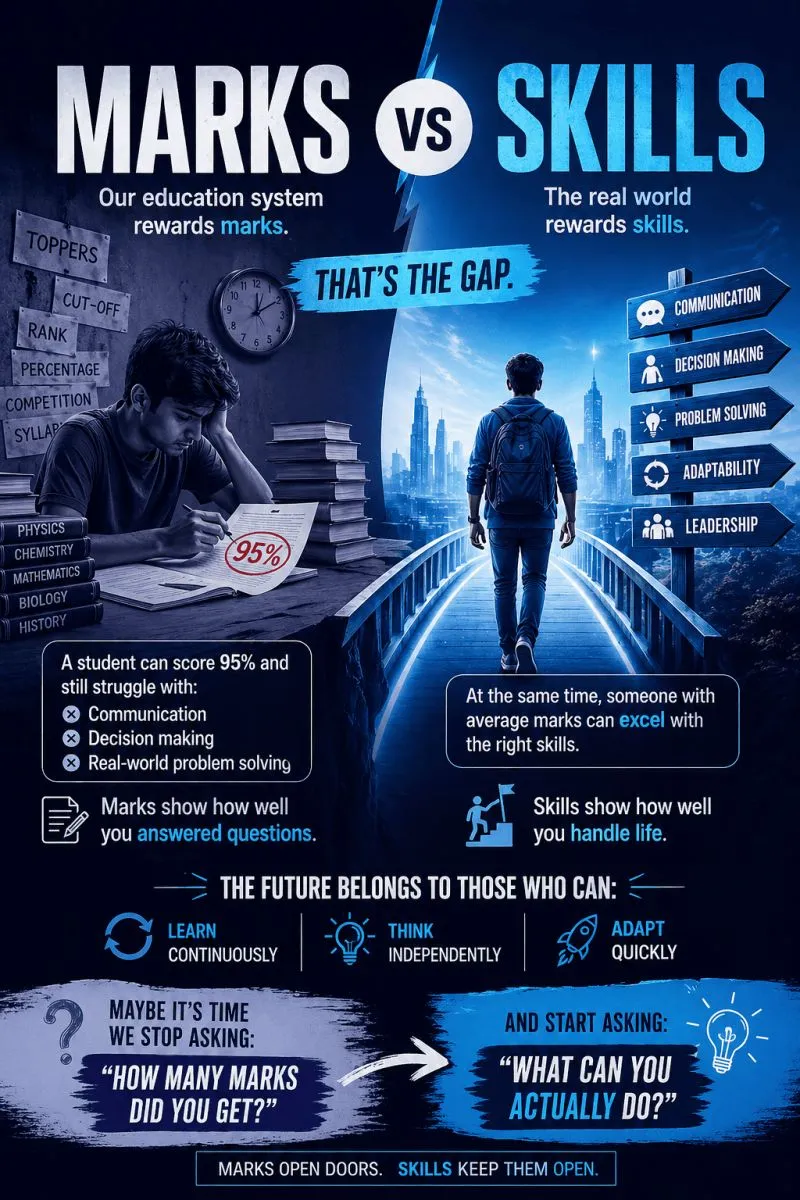
Marks vs Skills: Why the Real World Doesn't Care About Your Percentage
Our education system rewards marks. The real world rewards skills. Understanding that gap might be the most important lesson of all.
Every year, students spend months preparing for exams. They memorize formulas, practice past papers, and optimize their answers for maximum marks. And when results come out, those marks become everything — a measure of intelligence, a predictor of success, a label that follows students for years.
But there’s a problem with that story.
The real world doesn’t grade on a curve. It doesn’t give marks. And it almost never asks questions with predefined correct answers.
The Gap Nobody Talks About
A student can score 95% and still struggle with basic communication. They can top their class and freeze when asked to make a decision under pressure. They can memorize every formula in the textbook and have no idea how to apply any of them to a real problem.
At the same time, a student with average marks — but strong problem-solving instincts, the ability to communicate clearly, and the habit of continuous learning — can walk into the real world and thrive.
This isn’t an argument against studying hard or doing well in exams. Marks matter. They open doors. They reflect effort and discipline.
But marks show how well you answered questions in a controlled environment.
Skills show how well you handle life.
What the Real World Actually Rewards
Think about the people who succeed long-term — in careers, in business, in life. What do they have in common?
It’s rarely a perfect academic record. More often, it’s a combination of:
- The ability to communicate — clearly, confidently, and with empathy
- Decision-making under uncertainty — because real problems rarely come with four options and one correct answer
- Adaptability — the willingness and ability to learn new things as the world changes
- Problem-solving — not solving textbook problems, but figuring out messy, real-world challenges with incomplete information
These skills aren’t tested in most exams. Which means students can graduate without ever developing them — and not realize what’s missing until they’re already in the real world.
The Question We Should Be Asking
Our education system has spent decades asking: “How many marks did you get?”
It’s a reasonable question. But it’s incomplete.
A more important question — one that better predicts long-term success — might be: “What can you actually do?”
Can you learn something difficult on your own? Can you explain a complex idea simply? Can you work through a problem you’ve never seen before? Can you adapt when the situation changes?
Those abilities matter more than any percentage. And the sooner students — and the systems that educate them — understand that, the better prepared they’ll be for what actually comes next.
Marks are feedback. They’re useful. But they are not the destination.
The destination is a life where you can think, adapt, create, and keep growing.
No scorecard can measure that.