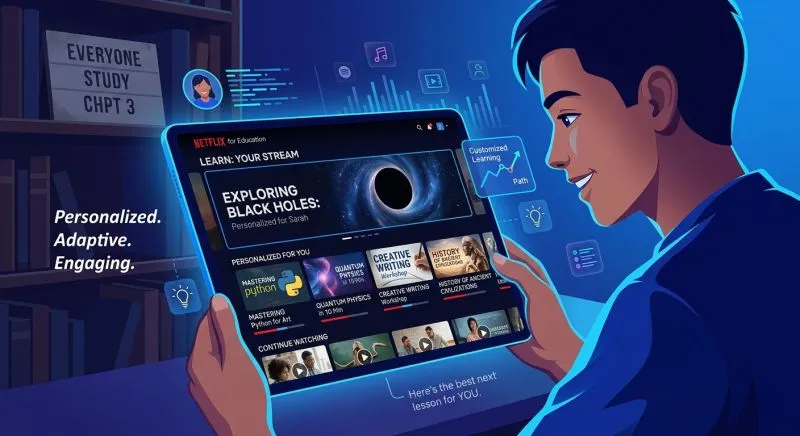
If Netflix Designed Education: Why Personalization Is the Future of Learning
Students already expect personalized experiences everywhere else. Education may be the last major industry still treating everyone the same — and that probably won't last.
Every morning, millions of students open their school apps, sit down in their classrooms, and receive the same instruction as everyone else around them.
“Everyone, open Chapter 3.”
Meanwhile, those same students go home, open Netflix, and are greeted by a homepage that looks completely different from their friend’s. Their Spotify playlist is curated to their taste. Their YouTube feed knows exactly what they want to watch next. Their Instagram shows them content so relevant it sometimes feels unsettling.
The contrast is striking.
The Personalization Gap
We live in an era of radical personalization. Algorithms built by some of the most sophisticated engineering teams in the world spend enormous resources figuring out exactly what each individual user wants — and delivering it.
The result? Engagement. Retention. Hours spent on platforms because the content feels relevant, well-timed, and perfectly matched to where you are right now.
Now compare that to the average learning experience.
Same content for every student. Same pace. Same explanation. If it doesn’t click for you the way it’s presented, that’s largely your problem to solve. Move on — the class isn’t waiting.
Students who are ahead get bored. Students who are behind get lost. And the students in the middle get an education that was designed for an average that doesn’t actually describe any individual person.
What “Netflix for Education” Would Actually Look Like
The Netflix model isn’t just about entertainment preferences. The underlying principle is powerful: use data about where someone is right now to deliver the most relevant next experience.
Applied to education, that looks like:
- A student who has mastered basic algebra being automatically moved toward more challenging problems — not held back by a class-wide pace
- A student who is struggling with a specific concept receiving a different explanation, a different example, or a different format — not just the same thing repeated louder
- A learning path that adapts in real time based on what a student gets right, what they get wrong, and how long they take to respond
- Recommendations for what to study next based on individual progress, not a standardized curriculum calendar
This isn’t a fantasy. The technology to do this exists. Adaptive learning platforms are already doing versions of it. AI tutors can already adjust difficulty and explanation style based on student responses.
Why Education Has Been Slow to Change
Unlike Netflix, education carries enormous institutional weight. Curricula are standardized for good reasons — consistency, fairness, shared knowledge. Teachers are managing 30+ students at once. Assessment systems are built around uniform standards.
These aren’t trivial constraints. Personalization at scale in education is genuinely hard.
But “hard” and “impossible” are different things. And the gap between what students experience in their learning environments versus every other digital environment they inhabit is becoming increasingly difficult to ignore.
Students already know what personalization feels like. They experience it every day. When their education feels generic by comparison, the contrast doesn’t go unnoticed.
The Shift That’s Coming
Education may be the last major industry still treating everyone the same. And that probably won’t last — not because of ideology, but because the tools to do better are becoming more accessible every year.
The question isn’t whether personalized learning will become the norm.
The question is how long it takes — and how many students go through a one-size-fits-all system in the meantime.
Because every student who sits through lessons that are too fast, too slow, or explained in a way that doesn’t work for them is a student whose potential is being underserved.
They deserve better. And increasingly, the technology exists to give it to them.